


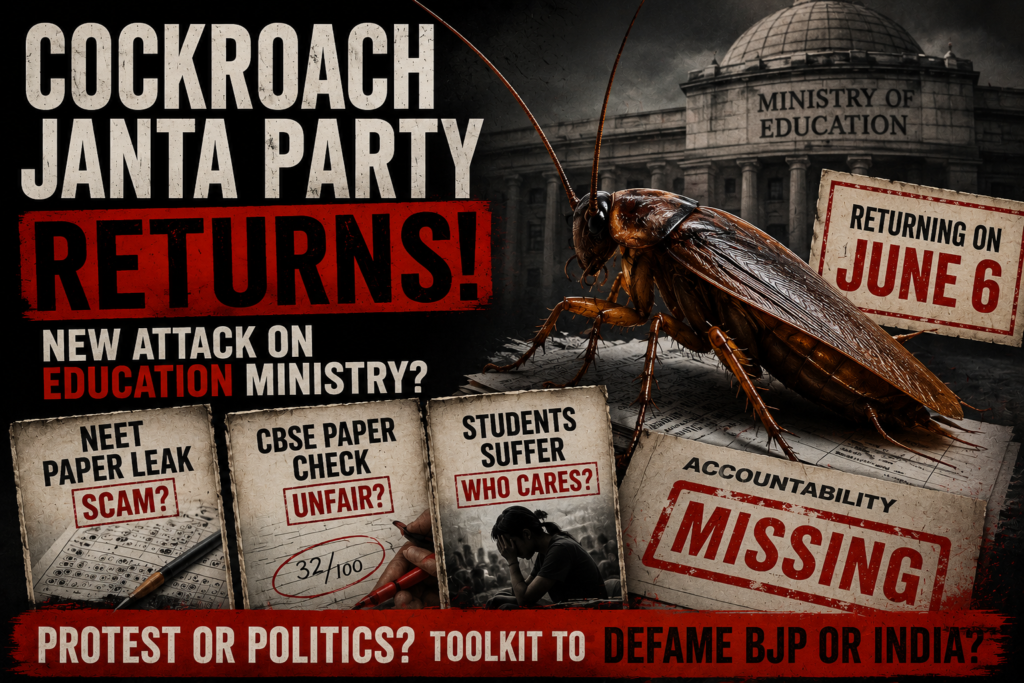
Latest news | Cockroach Janta Party founder Abhijeet Dipke’s India return sparks fresh controversy: Protest, politics, and the NEET debate
June 6 return plan puts education politics back in the spotlight
Abhijeet Dipke, founder of the Cockroach Janta Party, has announced that he will return to India on June 6 and seek the resignation of Union Education Minister Dharmendra Pradhan. The announcement has quickly triggered political debate across social media platforms.
Supporters claim the move is part of a broader campaign demanding accountability over examination-related controversies. Critics argue that the timing raises questions about whether India’s education system is being used as a political battleground ahead of future elections.
The bigger question is whether this is a genuine protest movement or another attempt to shape a narrative against the BJP-led government.
Why is Dharmendra Pradhan being targeted?
The Education Ministry came under pressure after allegations related to the NEET examination process and concerns regarding examination management.
Opposition leaders and activists have repeatedly demanded accountability from the ministry. Some groups have called for institutional reforms, while others have sought direct political responsibility from senior officials.
Abhijeet Dipke’s demand for Dharmendra Pradhan’s resignation appears to be linked to these larger concerns surrounding examination governance.
The shadow of the NEET paper leak controversy
The NEET controversy became one of the most discussed education issues in recent years.
Questions were raised about:
- Examination security
- Alleged paper leak networks
- Fairness of the selection process
- Impact on lakhs of students preparing for medical admissions
Investigating agencies carried out inquiries and several arrests were made in connection with alleged irregularities. The controversy generated nationwide protests and legal challenges.
For many students, the issue was never about politics. It was about trust.
When students spend years preparing for one examination, even the perception of unfairness can damage confidence in the system.
CBSE paper checking concerns continue to surface
Alongside NEET, concerns regarding CBSE evaluation processes frequently appear during result season.
Students often raise complaints related to:
- Marking inconsistencies
- Re-evaluation procedures
- Transparency in answer-sheet assessment
- Delays in grievance resolution
Education experts generally argue that examination boards should continuously improve transparency to maintain public confidence.
While CBSE has introduced several reforms over the years, demands for greater accountability continue whenever large-scale examinations produce unexpected results.
Is this a political campaign or a genuine student movement?
This is where the debate becomes complicated.
One side argues that student-related issues deserve public protests and political pressure. Education affects millions of families and governments should face scrutiny whenever major examination controversies emerge.
The other side believes that some activists selectively amplify issues when they can damage the image of the central government. According to this view, examination controversies become political weapons rather than platforms for long-term reform.
Evidence supporting either claim remains a matter of political interpretation.
Does international campaigning hurt India’s image?
A section of commentators argues that taking domestic political disputes to international platforms can damage India’s reputation abroad.
Their argument is simple: education reforms, examination failures, and governance disputes should primarily be addressed through Indian institutions, courts, and democratic processes.
Others disagree. They maintain that public advocacy, including international attention, is a legitimate form of democratic pressure when citizens believe institutions are not responding adequately.
The answer often depends on one’s political perspective.
What students actually want
Lost in the political noise is the demand that most students repeatedly make:
- Fair examinations
- Leak-proof question papers
- Transparent evaluation
- Faster grievance redressal
- Equal opportunity
Whether the protest comes from political activists, student groups, or civil society organizations, these demands remain largely unchanged.
The road ahead
Abhijeet Dipke’s return on June 6 is likely to generate media attention and fresh political arguments. Yet the larger issue extends beyond one individual or one political party.
The credibility of India’s examination system remains a national concern. Every controversy, whether related to NEET, recruitment exams, or board examinations, chips away at public trust.
The real test for policymakers is rebuilding that trust through stronger examination security, transparent evaluation systems, and faster accountability mechanisms.
Frequently Asked Questions (Q&A)
Who is Abhijeet Dipke?
Abhijeet Dipke is known as the founder of the Cockroach Janta Party and has been active on social media and public campaigns related to political and governance issues.
Why is he seeking Dharmendra Pradhan’s resignation?
His stated demand is linked to concerns surrounding examination management and accountability within the education system.
What was the NEET paper leak controversy?
The controversy involved allegations of examination irregularities, including possible paper leaks and unfair practices affecting medical entrance candidates.
Is there evidence that the campaign is intended to defame India internationally?
No publicly established evidence conclusively proves such an objective. The claim remains a matter of political debate and opinion.
What concerns do students raise regarding CBSE paper checking?
Common concerns include marking consistency, transparency in evaluation, and access to effective re-evaluation mechanisms.
What is the biggest issue at the center of this debate?
Public trust in India’s examination and education system remains the central issue.